
 By Sandra Saluti
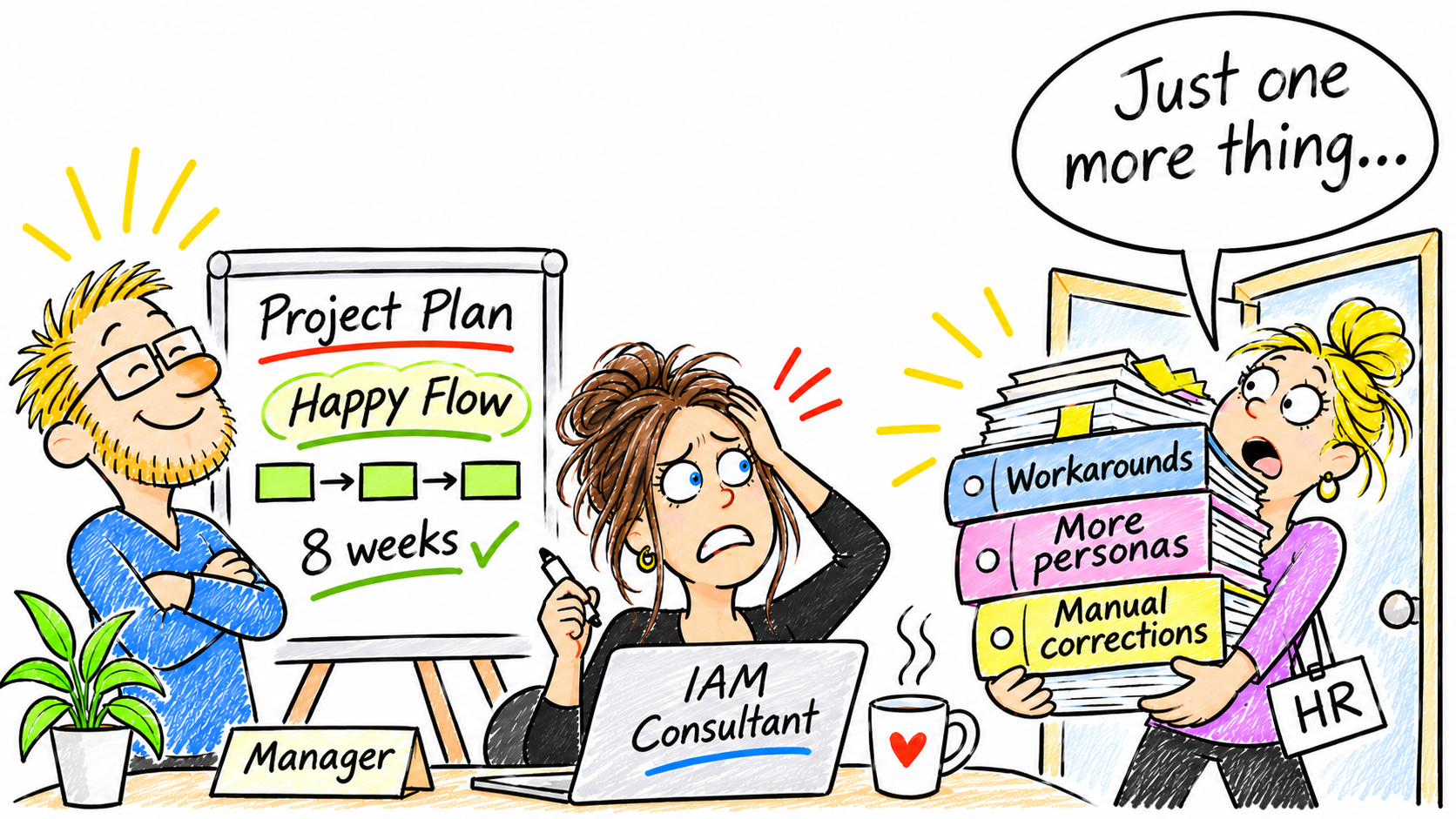
Since taking on the Solutions Owner role and expanding my area of responsibility, I’ve started reflecting on how I approach projects. Much of that approach has developed through years of implementing identity solutions, integrating systems and dealing with processes that rarely work quite as described.
I decided it was time to document some of those lessons. Not as a formal methodology, but as a practical approach to avoiding common project pitfalls.
The problem with the happy flow
Most projects start with a business need: a process takes too long, involves too much manual work or creates unnecessary risk. The organisation wants to improve or automate it.
An initial meeting is held. Management presents the desired outcome and the process diagrams. Based on the documented happy flow, an estimate is made.
Eight weeks. Sounds achievable.
Then, during a customer stand-up, someone invites HR.
“What happens if…?”
Suddenly, there are manual corrections, undocumented exceptions, additional personas and dependencies that were never part of the original discussion. The documented To-Be process turns out to be a poor representation of the actual As-Is process.
This is often where Scope Creep starts. Not because someone keeps adding requirements, but because the original scope was based on an incomplete understanding of the process.
And that’s an important distinction: discovering missing requirements isn’t necessarily Scope Creep. It may simply mean the project started before the analysis was complete.
Understand the process before designing the solution
Start by understanding what the organisation wants to achieve. What problem are they trying to solve, and what does success look like? Talk to management, process owners and other stakeholders.
Then investigate the actual environment. Collect documentation from relevant sources and use scripts and technical tools to extract data and build inventories. Depending on the project, this could include identities, attributes, groups, applications, access assignments and integrations.
Compare your findings with the documented processes and business requirements. Identify gaps and inconsistencies, but don’t stop at the documentation.
Now it’s time to find the most frustrated administrator in the organisation and offer them a free therapy session. You’re the therapist, so let them talk. Listen to the complaints about manual corrections, endless workarounds, broken processes and all the things they’ve been trying to get someone to fix for years. Ask questions. Take notes. There is usually a reason behind every workaround.
You might even improve the company’s next employee pulse survey along the way. An unexpected benefit of your therapy sessions!

Avoid building Governance Debt
The next step is crucial. Now you know all the workarounds that keep the current process running. But is that really a process worth automating? Probably not.
If you simply automate what people are doing manually today, you’re likely to build Governance Debt that someone will have to repay eventually.
Take a step back. Think about what you’ve learned and look for a better process that eliminates the need for all those manual adjustments in the first place.
That’s the process you want to implement in your new governance solution.
Design the solution around the requirements
A PowerShell script? An Entra ID Governance Access Package? A Lifecycle Workflow? A third-party tool? Perhaps a combination?
The choice should follow the requirements, not the other way around.
Consider security, maintainability, scalability, integrations and cost. Who will own the solution after implementation? Will it support future requirements? Are the licensing and operational costs justified?
Now define the project scope. Document what is included, what is excluded and which assumptions the design depends on. New requirements should be assessed through Change Control rather than silently absorbed into the original delivery.
Almost anything can be built. The question is whether it should.
Make your testers your worst enemies
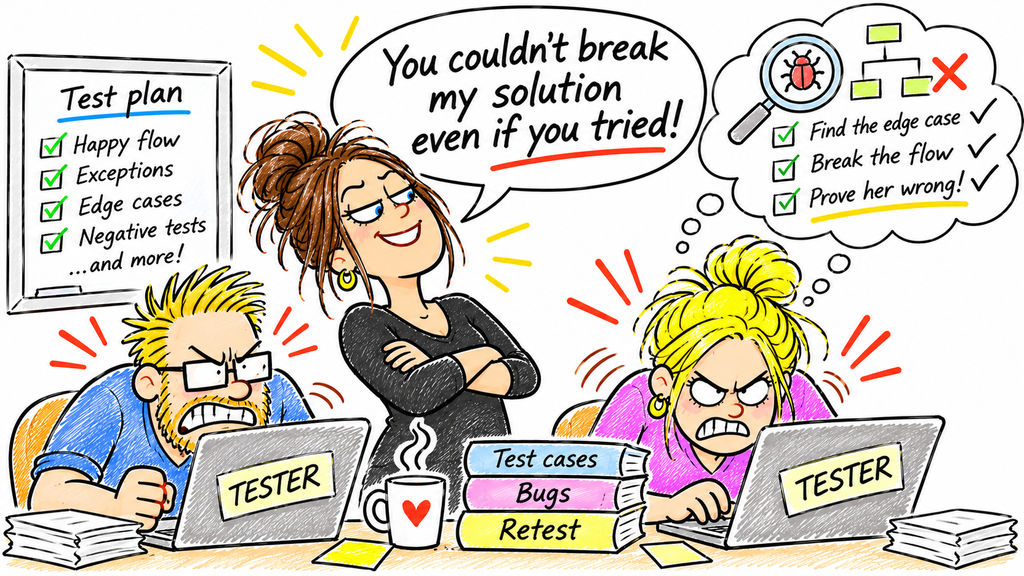
I sometimes think the best way to motivate your testers is to make them slightly annoyed with you. Tell them you’re confident they won’t be able to break your solution. Say it with enough confidence to make them determined to prove you wrong.
When you’ve frustrated the testers enough and they’re looking at you with disdain they will come up with scenarios like an employee changes department on their last day, their new manager is also leaving, and HR has already terminated their account. Is it reasonable? Probably not but if you’ve worked in IT for some time you know it will happen
That’s exactly the kind of scenario I’m hoping they’ll come up with. The more determined they are to break my solution, the better.
And when they eventually succeed, thank them. They’ve just saved you from discovering the problem in production.
Or you could just skip all of this…
Of course, there’s another approach.
Implement the happy flow, deploy it into production and let Service Desk handle everything. You’ll look great, you delivered on time and under budget, who cares that it’s more expensive and you’re making enemies for life, you’ve already spotted your next victimcustomer
The irony is that this approach will probably take considerably longer than doing the analysis properly in the first place.
You’re effectively moving the analysis phase into production, where every missing requirement becomes an incident, every workaround becomes another support task and every correction competes with the next development activity.
And that employee pulse survey we talked about earlier? I suspect those numbers might be heading in the opposite direction.
A few things worth remembering
Scope Creep isn’t always caused by customers changing their minds. Sometimes, it starts with an incomplete understanding of the business problem. A proper analysis can save considerable time and trouble later.
The happy flow is a starting point, not a project plan. Real life rarely follows a flowchart.
Author
Discover more from Agder in the cloud
Subscribe to get the latest posts sent to your email.
 Åsne Holtklimpen